Training-Free Task Vectors for Controlling LLM Behavior
I am excited to share our latest research, “Training-Free Task Vectors for LLM Behavioral Control,” which has been accepted at NeurIPS 2026!
In this paper, co-authored with Gabriel J. Perin, Lucas Boscaini, André Araujo, and Nina S. T. Hirata, we tackle a fundamental challenge in post-training model editing: How can we permanently steer LLM behaviors without the heavy computational cost of fine-tuning?
The Problem: The High Cost of Classical Task Vectors
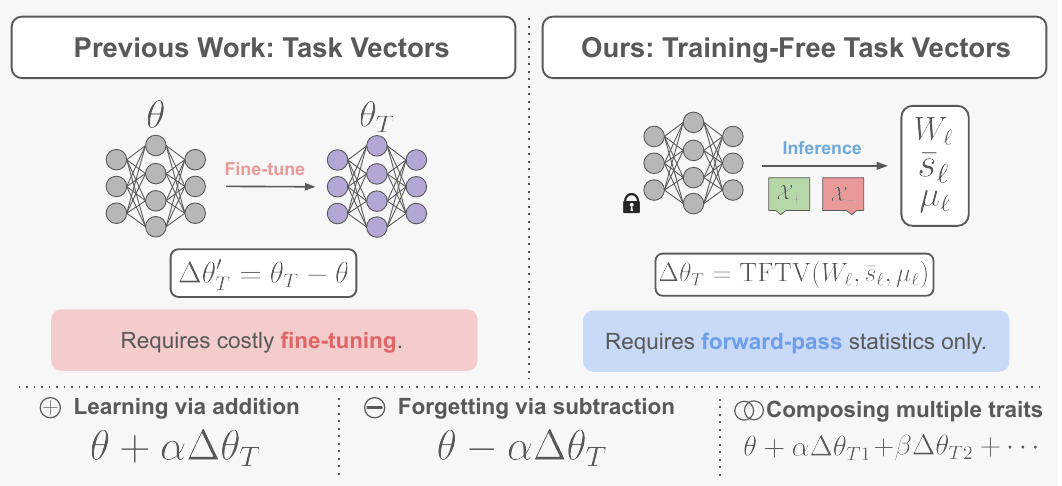
Task vectors have emerged as a powerful paradigm for model editing. Traditionally, a task vector is constructed by taking the parameter-level difference between a fine-tuned model and its base checkpoint ( $\Delta\theta = \theta_{\text{fine-tuned}} - \theta_{\text{base}}$ ).
These vectors exhibit intuitive vector arithmetic properties directly in weight space:
- Addition: Injecting or amplifying new capabilities and behaviors.
- Subtraction: Removing unwanted traits or safety hazards.
- Composition: Combining multiple task vectors to multi-steer a model simultaneously.
However, traditional task vectors have a glaring bottleneck: they require fine-tuning first. To control a behavior, you must first spend significant time and compute training a dedicated model checkpoint that expresses that behavior.
The Solution: Training-Free Task Vectors (TFTV)
Training-Free Task Vectors (TFTVs) eliminate the fine-tuning requirement entirely.
Instead of subtracting weights from fine-tuned checkpoints, TFTV maps activation-space steering directions directly into rank-one weight-space updates using only forward-pass statistics from contrastive prompts.
$$\text{Contrastive Prompts} \longrightarrow \text{Activation Steering} \longrightarrow \text{Rank-1 Weight Update (TFTV)}$$
Key Advantages of TFTV:
- Zero Fine-Tuning or Optimization: TFTVs require only forward-pass statistics, making them orders of magnitude faster and cheaper to compute.
- Persistent Edits: Unlike activation steering (which intervenes dynamically at every forward pass during inference), TFTVs directly modify the model’s weights ($\theta_{\text{edited}} = \theta + \Delta\theta_{\text{TFTV}}$).
- Linear Weight Arithmetic: TFTVs satisfy linear arithmetic properties in weight space, supporting:
- Learning via addition: Amplifying desirable traits.
- Forgetting via subtraction: Suppressing unwanted behaviors (e.g., toxicity, hallucination, sycophancy).
- Composition: Combining multiple trait edits at once.
Empirical Results
We evaluated TFTV across four instruction-tuned LLMs (including Llama-3.1-8B-Instruct) targeting traits such as toxicity/evilness, hallucination, and sycophancy.
A major highlight is trait composition:
- When applying a three-way suppression edit (suppressing evil, hallucination, and sycophancy simultaneously), TFTV reduces target trait scores to near zero.
- Crucially, TFTV achieves this while preserving general reasoning utility (maintaining baseline benchmark scores on MMLU and GSM8K), significantly outperforming traditional steering and weight-editing baselines.
Read the Paper & Try the Code
📄 arXiv Paper: Training-Free Task Vectors for LLM Behavioral Control (arXiv:2609.09054)
🌐 Project Website: tftv-llm.github.io
💻 Code & Demo: Available on GitHub and Google Colab
Feel free to check out the paper, try the Google Colab notebook, or reach out if you have thoughts or feedback on training-free post-training model control!